Share This Article
Every spring and fall, garden centers stack pallets of bagged mulch and soil by the entrance, and the math behind those pallets rarely gets a second look. A bag looks cheap. A delivered pile of mulch in the driveway looks like a commitment.
The two options are priced in different units, which is why they are hard to compare. Bags are sold by the cubic foot. Bulk material is sold by the cubic yard. Once both are converted to the same unit, the question of which one costs less mostly answers itself, with a few honest exceptions.
Start With the Conversion: 27 Cubic Feet in a Yard
A cubic yard is a box three feet on each side, which holds 27 cubic feet. That single number drives everything else. Texas A&M AgriLife Extension tells gardeners to multiply the yards they need by 27 to get cubic feet, then divide by the size of the bag.
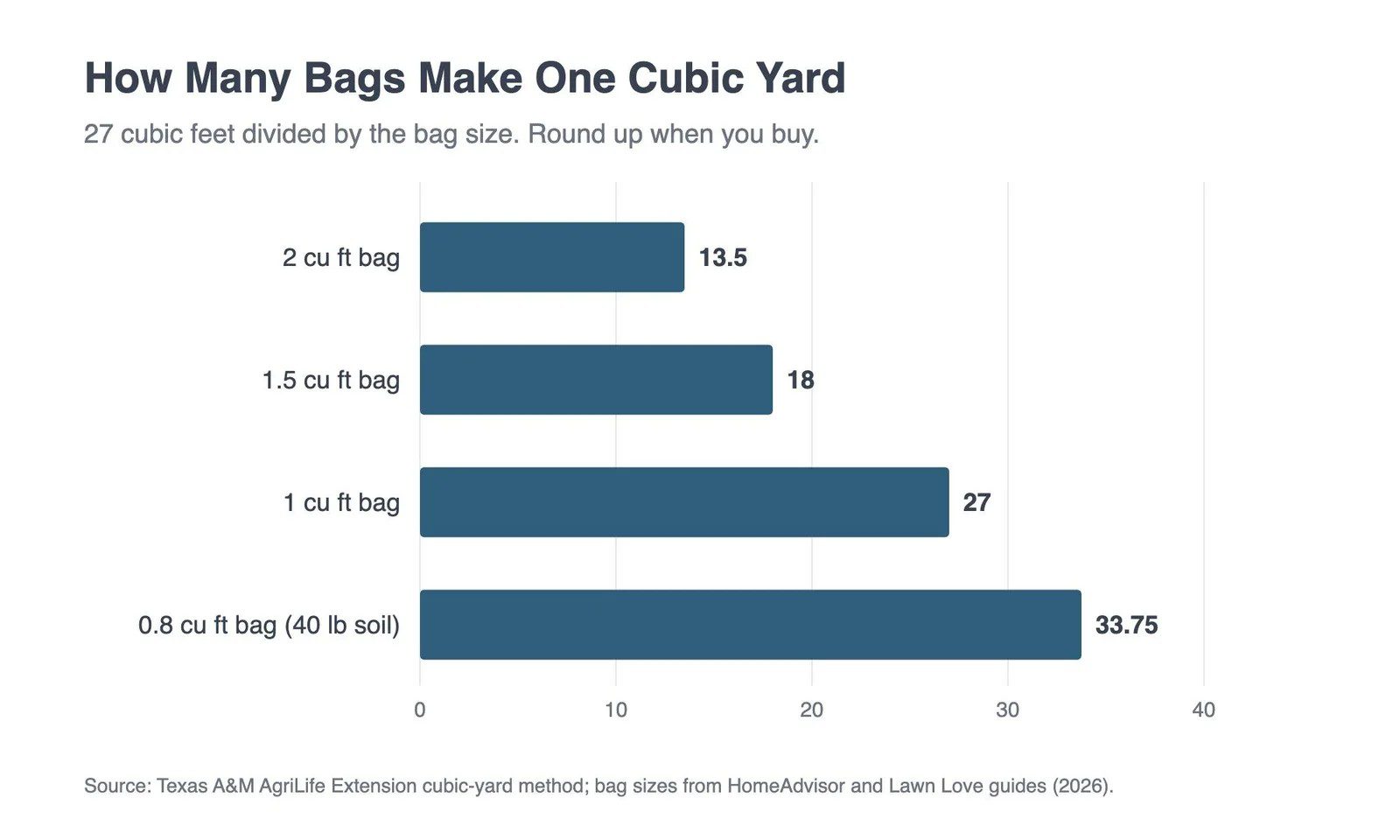
Common bag sizes make the conversion concrete. Retailers usually sell soil and mulch in 1 or 2 cubic foot amounts, according to the same extension guide. Here is how many bags it takes to equal one cubic yard at each size:
-
2 cubic foot bags (typical for mulch): 27 divided by 2 is 13.5, so 14 bags
-
1.5 cubic foot bags: 27 divided by 1.5 is 18 bags
-
1 cubic foot bags: 27 bags
Lawn Love’s 2026 topsoil cost guide adds one more data point: a 40-pound bag of topsoil holds roughly 0.80 cubic feet, so it takes about 34 of them to make a yard.
Bags needed for one cubic yard at common bag sizes. Source: Texas A&M AgriLife Extension method.
How Much Material a Project Actually Needs
Before comparing prices, it helps to know the volume. Texas A&M AgriLife Extension’s guide to estimating compost, soil, and mulch gives the formula: length in feet times width in feet times depth in inches divided by 12, with the result divided by 27.
HomeAdvisor’s mulch cost guide recommends a depth of two to three inches. A 10-by-20-foot bed at three inches works out to 10 times 20 times 0.25, or 50 cubic feet. Divided by 27, that is about 1.85 cubic yards, or 25 two-cubic-foot bags.
Many weekend projects land in exactly that range. They are large enough that the bag count gets tedious, and small enough that a full dump truck makes no sense.
Price per Cubic Foot: Mulch
HomeAdvisor’s mulch guide, updated in June 2026, says bags hold an average of 1.5 to two cubic feet and cost between $2 and $15 each. For a 2 cubic foot bag, that is $1.00 to $7.50 per cubic foot. Multiply by 27 and bagged mulch runs from $27 to $202.50 per cubic yard.
The same guide puts bulk mulch at $20 to $80 per cubic yard, plus a delivery fee of $50 to $100. Divided by 27, bulk mulch costs about $0.74 to $2.96 per cubic foot before delivery.
HomeAdvisor’s separate fill dirt and delivery guide, updated a day later, lists mulch at $50 to $150 per cubic yard. That is about $1.85 to $5.56 per cubic foot. The two pages likely measure different things, such as material alone versus material with delivery folded in, but neither page says so directly. The safe reading is that bulk mulch prices vary widely by product and region.
Price per Cubic Foot: Topsoil
Lawn Love’s guide, updated October 5, 2026, prices a 40-pound bag of topsoil at $2 to $5. At 0.80 cubic feet per bag, that is $2.50 to $6.25 per cubic foot. Multiplied by 27, bagged topsoil comes to $67.50 to $168.75 per cubic yard, which matches the guide’s own estimate of $68 to $170.
Bulk topsoil is far cheaper per unit. HomeAdvisor lists it at $12 to $55 per cubic yard, or about $0.44 to $2.04 per cubic foot. Lawn Love’s range of $10 to $50 per yard is close to that. Lawn Love also notes that topsoil delivery can cost between $80 and $170.
For bulk ranges on other materials, including fill dirt, sand, and gravel, there is also a recent breakdown of what small bulk loads cost per cubic yard, along with guidance on rounding orders up, so a second trip is not needed.
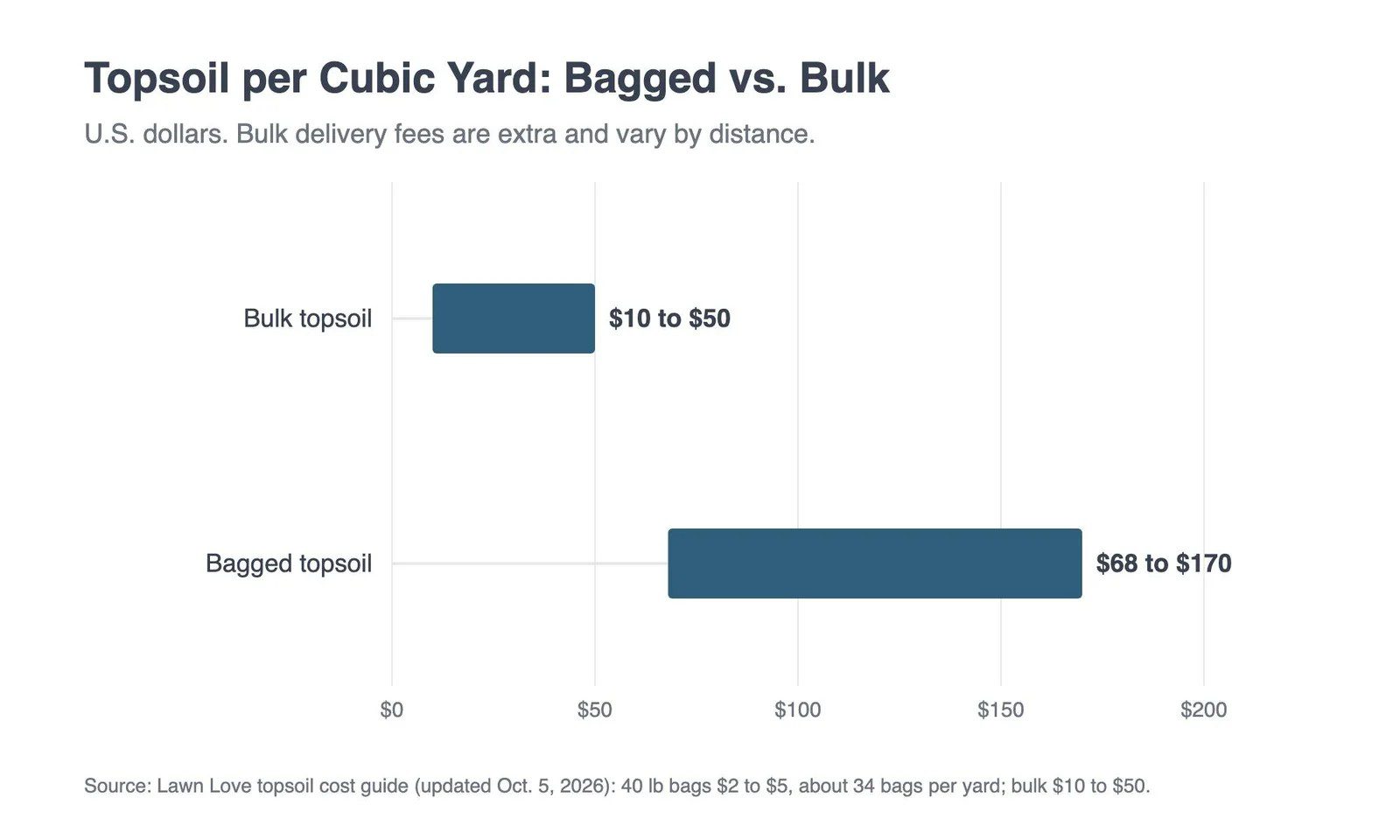
Topsoil cost per cubic yard, bagged vs. bulk. Source: Lawn Love, October 2026.
Finding the Break-Even Point
Per cubic foot, bulk wins almost every time. The catch is delivery, which is a fixed cost that lands on the first yard and spreads thinner with each one after it. The break-even question is how many bags it takes before the delivery fee pays for itself.
Using the midpoints of HomeAdvisor’s mulch ranges shows how this works. Bulk mulch at $50 per yard plus a $75 delivery fee comes to $125 for one yard. That one yard equals 14 two-cubic-foot bags, so bags win if they cost less than about $8.93 each, which is $125 divided by 14.
At two yards, the bulk total is $175 for 27 bags’ worth of material, which sets the break-even at about $6.48 per bag. At three yards, it is $225 for 41 bags, or about $5.49 per bag. The more you buy, the cheaper a bag has to be to keep up.
Topsoil follows the same pattern but tips toward bulk sooner. One yard at the midpoint of HomeAdvisor’s range, $33.50, plus the midpoint of Lawn Love’s delivery range, $125, totals $158.50, close to the top of the bagged range for 34 bags. At two yards, bulk comes to about $192, while 68 bags would cost $136 to $340.
These midpoints are illustrations, not quotes. A homeowner who can find bags at the low end of the published ranges may beat bulk on a one-yard job. Someone paying the high end will likely save money on bulk even for a single yard.
Costs Missing From the Price Tag
Labor is the first. At 40 pounds each, the 34 bags in a yard of topsoil add up to about 1,360 pounds lifted into a cart, into a vehicle, out of the vehicle, and across the yard. A bulk delivery is dumped once, though it still has to be moved by wheelbarrow from the pile to the beds.
Packaging is the second. One yard of mulch in 2 cubic foot bags means 14 plastic bags to dispose of. The EPA counts film products, including bags and sacks, in its plastic containers and packaging category. EPA’s containers and packaging data estimate that 14.5 million tons of plastic containers and packaging were generated in 2018, with a recycling rate of 13.6 percent and over 69 percent landfilled.
Storage cuts both ways. Bags stack neatly and keep for later. A bulk pile needs a spot that can handle a delivery truck, and it sits in the open until it is spread. HomeAdvisor notes that bags arrive clean, sealed, and easy to carry into tight spaces or raised beds, which matters for small yards and fenced lots.
Consistency is the last factor. Bags carry a printed label, and every bag in a pallet should match. Bulk quality depends on the supplier, so it is worth asking what the material is, where it came from, and if you can see the pile first.
Delivery Fees, Minimums, and Hourly Rates
The delivery line is where bulk quotes get hard to compare. HomeAdvisor’s fill dirt guide notes that some pros include delivery in the per-yard price while others list it separately, and that haulers without a set delivery fee may charge $65 to $100 per hour. Some also require a minimum order.
A minimum can change the math on small jobs. If a supplier requires two yards and the project needs one, the break-even point moves sharply toward bags. The simplest protection is to ask every supplier for a single delivered price that includes material, distance, and drop-off.
A Measured Look at the Market
The published numbers support a general rule: bags make sense for touch-ups and small beds, and bulk usually pays off somewhere between one and two yards. The exact crossing point depends on two variables the national guides cannot settle, which are local delivery fees and the bag price on the day you shop.
The most telling detail in the data is how wide the ranges are. Two cost pages from the same publisher, updated a day apart, list bulk mulch at different price bands, and bagged mulch spans a range of more than seven to one. Until suppliers quote delivered prices consistently, homeowners will keep doing this arithmetic themselves, one cart or one truckload at a time.
Disclosure: The author also wrote the Idea Crossing guide cited above.